How to Respond to Reviews on Google Business Profile
A practical guide to writing replies that acknowledge the customer, protect privacy, and move the conversation toward a useful next step.


How do you respond to reviews on Google Business Profile?
To respond to reviews on Google Business Profile, open the profile you manage, find the review, and choose the reply option. Write a short message that recognizes the specific experience, answers what you can, and gives the customer a sensible next step. A useful response is usually two to five sentences rather than a long defense of the business.
Start with the customer’s actual words, not with a generic phrase such as “Thanks for your feedback.” Mention the service, product, team, or situation only when it is safe and accurate to do so. For a positive review, appreciation and one concrete detail are enough. For a mixed or negative review, acknowledge the concern before explaining what you will do next.
Keep the public reply public. Do not include order numbers, health information, phone numbers, private disputes, or details that could identify a customer. If the issue needs account research, invite the customer to contact the business through a private channel and continue the case there.
A reliable reply formula
Acknowledge the experience, add one specific detail, explain the next step, and protect anything that belongs in a private conversation.
What to check before you reply
Read the entire review twice. The star rating is a useful signal, but the written details tell you what the customer actually wants other readers to understand. A three-star review may contain a compliment plus one fixable problem; a one-star review may combine a service failure with a misunderstanding about a policy.
Check the facts you can verify without guessing. Look at the service date, staff notes, order or appointment record, and any existing support conversation. If you cannot verify the situation, do not invent an explanation in public. A calm request for private details is more credible than a confident answer built on assumptions.
Choose the goal before you draft: thank the customer, clarify a point, repair trust, or move a sensitive case to a private channel. This prevents the reply from becoming a sales pitch or an argument.
- Identify the specific experience the reviewer mentioned.
- Separate facts you can verify from claims you still need to investigate.
- Decide whether the issue can be resolved publicly or needs private follow-up.
- Remove personal data, order details, health information, and internal notes.
- Use the same calm tone you would use with a customer standing in front of you.
- Proofread the reply once for blame, sarcasm, promises, and accidental admissions.
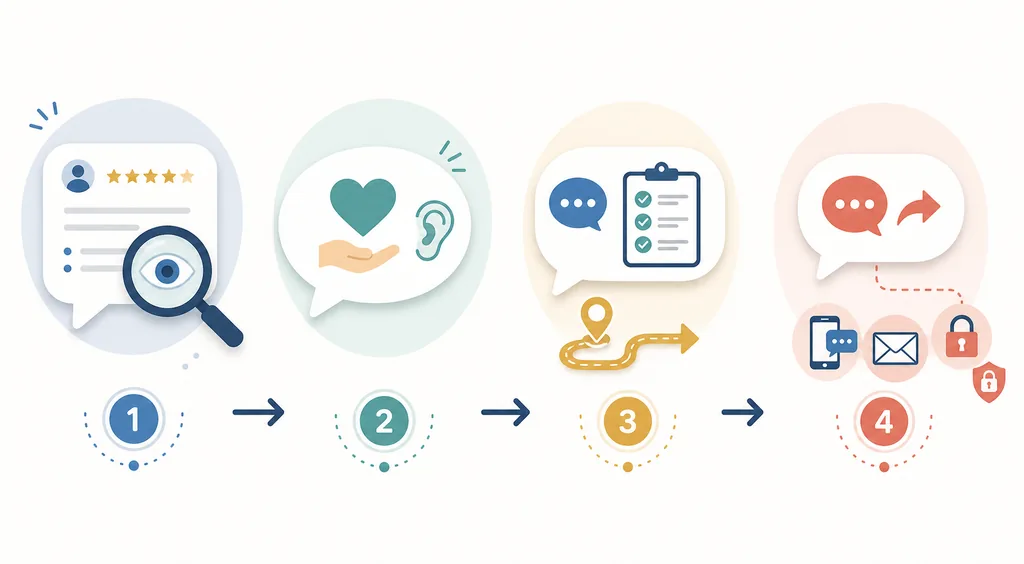
The four-step response framework
The best response is not the longest response. A simple four-step structure helps a business stay specific without turning every review into a formal statement. Use the same structure for positive, mixed, and negative feedback, then change the emphasis to match the situation.
Think of the framework as a guardrail, not a script. If a review is obviously spam, contains private information, or raises a serious safety issue, follow the platform’s reporting and support process instead of trying to solve everything in a public comment.
1. Read and identify
Name the real topic of the review in your draft: a helpful employee, a delayed order, a missing feature, a clean room, or another concrete detail.
2. Acknowledge
Show that you understood the experience. Thank the reviewer for a positive detail, or recognize the frustration before you explain anything.
3. Answer and act
Add the useful next step: a brief clarification, a correction, an invitation to reconnect, or the operational improvement you can honestly promise.
4. Move sensitive details privately
Offer a direct contact route when account research is needed. Never ask the customer to post personal information in the public reply.
Google review response examples
Use the examples below as starting points, not as text to paste into every review. Replace the bracketed idea with a real detail from the customer’s experience. If the wording could apply to any business in any industry, it is probably too generic.
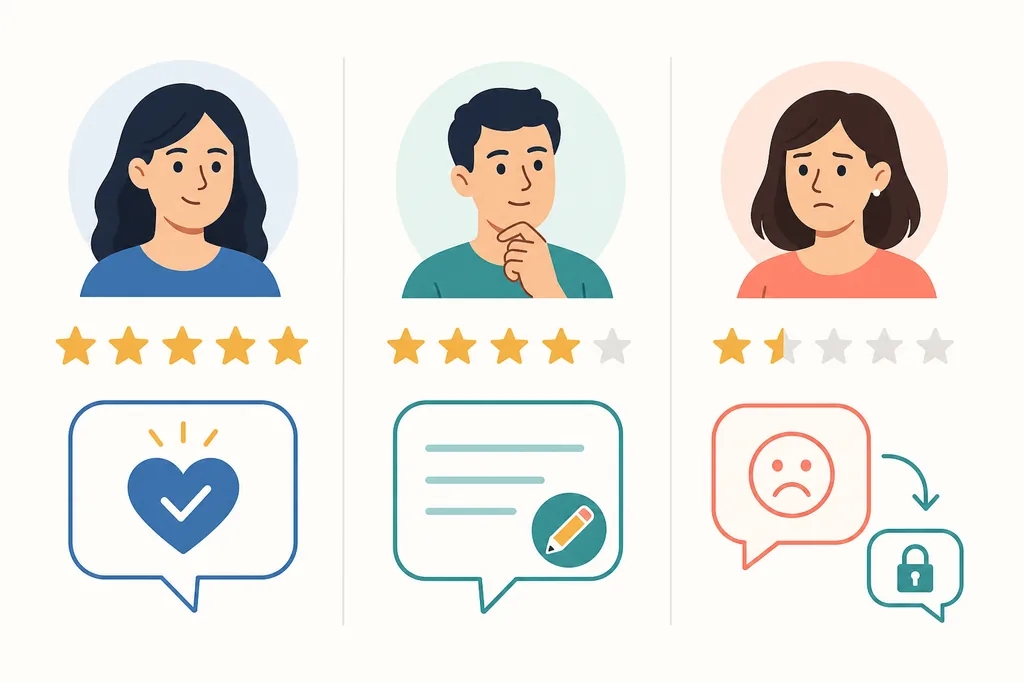
Positive review response examples should reinforce the detail the customer valued. Mixed-review replies should thank the customer while addressing the improvement point. Negative-review responses should reduce heat, avoid public debate, and offer a clear private follow-up path.
| Review type | Reply goal | Example response |
|---|---|---|
| Five-star review | Thank the customer and reinforce a real detail. | Thank you for mentioning the quick installation and the care our team took with your space. We’re glad the result worked well for you, and we appreciate you choosing us. |
| Short positive review | Add warmth without inventing details. | Thank you for the kind review. We’re pleased you had a smooth experience, and we hope to welcome you back whenever you need us. |
| Three-star review | Acknowledge the good and the gap. | Thank you for sharing both what worked and what felt slow. We’re glad the final result met your needs, and we’re reviewing the wait-time issue with the team. |
| Negative service review | Recognize frustration and move to resolution. | We’re sorry the visit did not meet the standard you expected. We would like to review what happened and make this right; please contact [channel] with your visit details so we can investigate privately. |
| Policy misunderstanding | Clarify without embarrassing the reviewer. | Thank you for raising this. Our current policy is [short accurate explanation], but we understand how the wording could be confusing. We’re updating the information so the next step is clearer. |
| Possible spam or wrong business | Avoid a public argument. | We want to look into this carefully, but we cannot match the details to a customer record. Please contact [channel] so our team can verify the situation and help if this review is about our business. |
How to respond to a negative Google review
A negative review is not a request to win an argument. Future customers are watching whether the business stays respectful when something goes wrong. The strongest public reply is often shorter than the original complaint because its job is to show accountability and open a path to resolution, not to publish every side of the dispute.
Avoid accusing the reviewer of lying, listing every internal effort, or asking them to delete the review before the issue is resolved. Do not offer a refund, discount, or legal conclusion in public unless the offer and wording have been approved for the situation. Keep the response focused on what you can verify and what the customer can do next.
If the complaint involves health, safety, harassment, threats, or personal data, limit the public reply to a neutral acknowledgement and move the matter to the appropriate private or official process. Document the case internally and use platform reporting tools when the content violates policy.
- Lower the temperature. Wait until you can write without sarcasm or defensiveness. A fast reply is useful only when it is accurate and respectful.
- Name the concern. Use one sentence that shows you understood the problem, without repeating sensitive details or admitting facts you have not checked.
- Offer a practical route. Give one private contact option and explain what information the team needs to investigate. Avoid sending the customer through a maze of generic links.
- Close the loop. If the issue is resolved, thank the customer for the opportunity to review it. Do not pressure them to change or remove their honest review.
Automation and AI: where they help and where they do not
Automation can help a busy business collect review text, group replies by tone, and prepare a first draft. It should not turn every customer message into the same automatic paragraph. The best workflow keeps a person responsible for facts, privacy, promises, and the final publish action.
If you use AI to draft a reply, provide only the context needed for the wording task and remove personal information first. Ask for a concise response that does not invent a resolution, does not blame the reviewer, and clearly marks any detail that still needs verification. Then compare the draft with the original review before publishing.
- Use AI for structure and tone, not for inventing customer history or business actions.
- Keep a human approval step for negative, sensitive, or policy-related reviews.
- Do not publish the same response to every review; vary the detail because the experience is different.
- Do not paste private customer records into a prompt unless your approved workflow allows it.
- Treat an AI draft as editable copy, not as proof that the issue has been solved.
Frequently asked questions
Can a business reply to Google reviews?
Yes. A verified business that manages the relevant Google Business Profile can reply to customer reviews. Use the profile’s review management area and keep the response relevant to the written experience.
How quickly should a business respond to a review?
Aim for a consistent response routine rather than a promise of an exact number of hours. Positive reviews can usually receive a short thank-you, while complaints deserve enough time to verify the facts before you publish.
What should I say in a response to a negative Google review?
Acknowledge the concern, apologize when the business fell short, explain the next practical step, and invite private follow-up. Avoid arguing, exposing customer details, or demanding that the reviewer remove the post.
Why is my response to a Google review not showing?
Check that you are using the correct profile, that the reply was submitted successfully, and that it follows Google’s content and review policies. If it still does not appear, use the official Business Profile support path rather than posting customer details publicly.
Should every review get the same reply?
No. A reusable framework is helpful, but the reply should mention a real detail and match the review’s tone. Repeated generic text can make the business look inattentive.
Can AI automatically reply to Google reviews?
AI can help prepare drafts or organize a response workflow, but a human should verify facts, privacy, tone, and any promised action before publishing. Fully automatic replies are risky for sensitive or unusual reviews.
Final checklist
Before you publish, confirm that the reply recognizes the real experience, contains no private information, and gives the reader a useful next step. A clear response can thank a happy customer, explain a confusing point, or show future customers that the business takes criticism seriously.
Use the four-step framework as a starting point, then personalize one sentence for every review. When the issue is complex, move the details to a private channel and keep the public response calm, accurate, and proportionate.