How to Address Negative Customer Feedback Reviews with AI
Use AI to organize a calm first draft, then verify the facts, protect private details, and keep the final reply human.


How do you address negative customer feedback reviews with AI?
Start by copying only the public review and the minimum business context needed to understand it. Ask AI to identify the customer’s main concern, separate verified facts from assumptions, and suggest a short reply that acknowledges the experience without inventing a resolution. Treat the result as a draft, not as a message that is ready to publish.
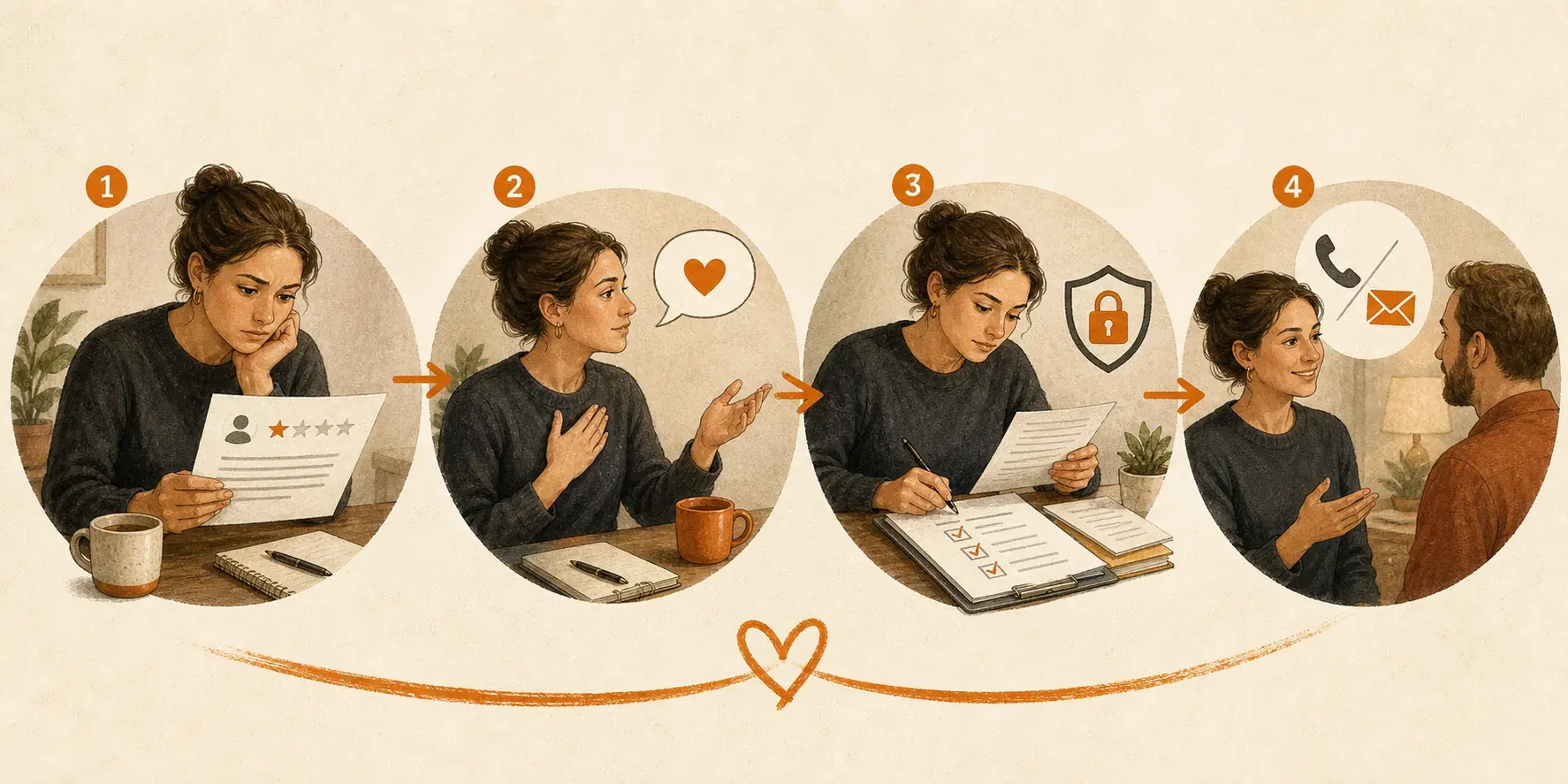
A strong response normally has four parts: recognize the specific concern, acknowledge the customer’s experience, explain the next practical step, and move account-specific details to a private channel. The wording should fit the situation. A delayed order, a rude interaction, a quality complaint, and a possible spam review should not receive the same paragraph.
If the feedback includes personal data, health information, payment details, threats, or an unresolved safety issue, do not paste those details into a general AI tool. Redact them, use the official support process, and keep the public reply short. The goal is to show care without exposing the customer or making a promise the team cannot keep.
The safest rule
Use AI for structure and tone; use a human for facts, privacy, accountability, and the final publish decision.
What to check before replying
Read the review twice before opening a writing tool. The star rating is only a signal. The written feedback may contain a compliment, a specific failure, a misunderstanding about a policy, or a request for contact. If you respond to the rating instead of the actual words, the reply will sound defensive or generic.
Next, check what the business can verify. Look at the service date, order or appointment record, staff notes, and any existing support conversation, but do not copy a full customer record into a prompt. If the situation cannot be matched confidently, say that you would like to investigate rather than inventing an explanation in public.
Finally, choose the purpose of the reply. You may be thanking the reviewer, correcting a public misunderstanding, repairing trust, or inviting a private conversation. One clear purpose keeps the response short and prevents the draft from becoming a sales pitch or a public argument.
- Name the specific experience mentioned in the review.
- Separate facts you verified from claims that still need investigation.
- Remove names, order numbers, phone numbers, addresses, health details, and internal notes.
- Decide whether the issue can be handled publicly or needs private follow-up.
- Check every promise, apology, refund reference, and policy statement before publishing.
- Read the draft once as a future customer who knows nothing about the private case.
A five-step framework for replying to a negative review
The framework below is useful for a single reply or a team process. It creates enough structure for AI to help without turning every customer into a template. Give the tool the review, the verified facts, the desired length, and the tone. Do not ask it to decide who is legally or morally right.
Keep the public message proportionate. Two to five sentences are often enough for the first reply. A long explanation can reveal more private information, sound like an argument, or make a small issue look larger than it is. When the case is complex, the public message should open the right door rather than contain the entire case history.
- 1. Identify the real issue. Summarize the review in one neutral sentence, such as a delayed delivery, a confusing charge, an unhelpful interaction, or a mismatch between expectations and the service.
- 2. Acknowledge the experience. Show that you understood the impact. Thank the customer for a useful detail, or recognize the frustration before adding context or a correction.
- 3. Add only verified context. Explain one fact or limitation that helps the reader, but do not guess, expose internal notes, or make the reviewer prove the complaint in public.
- 4. Offer one practical next step. Give a clear private contact route or explain the action the team can take. Avoid a list of generic inboxes and avoid promises that depend on an investigation.
- 5. Review before publishing. Compare the draft with the original review, remove personal data, check the tone, and confirm that a human is responsible for the final reply.
Negative review response examples
Use these examples as patterns, not as copy-and-paste scripts. Replace the bracketed idea with a real detail and remove anything the business cannot verify. The best response is usually specific enough to feel read, but restrained enough to protect the customer and the team.
When the reviewer is disappointed, the response should lower the temperature rather than match it. When the review contains a fair criticism, acknowledge it directly. When the business cannot find a matching record, invite private verification without accusing the reviewer of lying.
| Situation | Reply goal | Example response |
|---|---|---|
| Service problem | Recognize the failure and open a private path. | We are sorry that the visit did not meet the standard you expected. We would like to review what happened and make the next step clear; please contact [private channel] with your visit details so our team can investigate. |
| Delayed order | Acknowledge the delay without exposing order data. | Thank you for telling us about the delay. We understand how frustrating it is when an expected delivery does not arrive on time, and we would like to check the details with you privately. |
| Policy confusion | Clarify without embarrassing the reviewer. | Thank you for raising this. Our current policy is [short accurate explanation], but we can see how the wording was unclear. We are reviewing the information so the next step is easier to understand. |
| Mixed review | Keep the positive detail and address the gap. | Thank you for sharing what worked and what felt slow. We are glad the final result helped, and we are reviewing the wait-time issue with the team. |
| No matching record | Invite verification without a public accusation. | We want to look into this carefully, but we cannot match the details to a customer record from the information here. Please contact [private channel] so we can verify the situation and help if the review is about our business. |

How to respond when the customer may be wrong
A business can believe a review is inaccurate and still write a respectful response. Future customers are judging the reply as much as the original complaint. Publicly calling someone a liar, listing every internal record, or demanding that the review be deleted usually makes the situation harder to resolve.
Use a neutral correction only when it is necessary for readers to understand the situation. Keep the explanation short, avoid personal details, and invite the reviewer to a private channel where the team can check the account. If the review appears to be spam, about another business, or in violation of platform policy, use the platform reporting process instead of trying to win the case in the comment thread.
AI can help make a defensive draft calmer, but it cannot prove that the business is right. Ask it to identify unsupported claims and rewrite the response around what can be verified. A human should decide whether the correction is necessary and whether the wording could reveal confidential information.
- State what you can confirm. Use one concise fact and avoid presenting private records as public evidence.
- Do not assign motives. Skip words such as dishonest, malicious, confused, or fake unless an official process has established the relevant fact.
- Invite a private check. Offer one direct route and ask for the minimum details needed to locate the case.
- Report policy issues separately. Use the platform’s reporting or support tools for spam, impersonation, privacy violations, or content that breaks the published rules.
Privacy and safe AI use
An AI review response generator is useful for organizing ideas, adjusting tone, and producing a few editable options. It should not invent a refund, claim that a manager called the customer, or imply that an investigation is complete when it is not. Tell the tool what is verified and ask it to mark anything that still needs confirmation.
Before using AI, remove personal information that is not needed for the wording task. A public review may mention a person’s name, order number, phone number, address, medical information, or a private dispute. Keep those details in the approved business workflow and use a generic placeholder in the prompt.
Do not use AI to manufacture a customer story, hide a material relationship, or pressure someone to change an honest review. A polished reply cannot turn an unsupported claim into a fact. When a complaint involves safety, harassment, discrimination, legal threats, or sensitive personal data, involve the right internal or official process before publishing.
- Use only the minimum context needed to draft the wording.
- Replace private details with placeholders before sending text to a general AI service.
- Ask AI not to invent facts, outcomes, refunds, calls, or staff actions.
- Keep a human approval step for negative, sensitive, or policy-related reviews.
- Publish only a reply that the business can support and stand behind.
- Move account research and personal details to the approved private channel.
A repeatable human-review workflow
Teams get more consistent results when the AI step sits inside a small editorial workflow. Save a short internal checklist rather than a giant prompt. The checklist should tell the writer what to redact, what facts to verify, how long the public response should be, and who approves unusual cases.
For everyday feedback, the workflow can take only a few minutes. For a serious complaint, speed is less important than accuracy and privacy. Keep the public reply focused on the customer-facing next step and record the detailed investigation in the appropriate private system.
If you want help with the first draft, the Review Response Generator can turn the verified review context into an editable response. The output should still be checked against the original review before it is published.
- Redact the input. Remove personal data, order identifiers, internal notes, and anything not needed for the writing task.
- Write the facts. List the concern, the verified context, the desired next step, and any promise the business is actually authorized to make.
- Generate two drafts. Ask for one concise public reply and one slightly warmer option, both without invented details or public account research.
- Edit for the platform. Keep the final response readable, specific, and appropriate for the review platform. Remove jargon and unnecessary backstory.
- Approve and learn. Publish the human-approved version, then record recurring issues so operations can improve the underlying customer experience.
Frequently asked questions
Can AI write a response to a negative review?
Yes. AI can turn verified notes into a concise draft, suggest a calmer tone, and offer a few ways to acknowledge the concern. A person should verify the facts, privacy, promises, and final wording before publishing.
What should I say when a customer is wrong?
State only the short fact that readers need, avoid assigning motives, and invite a private conversation to check the details. Do not publish order records or call the reviewer dishonest in public.
How long should a negative review response be?
Two to five clear sentences are often enough for the first public reply. A complex case may need a short acknowledgement plus a private contact route rather than a long public explanation.
Should I paste the full review into an AI tool?
Only if the review contains no unnecessary personal or sensitive information and the tool is approved for that workflow. Otherwise redact names, identifiers, contact details, and private case history first.
Should a business offer a refund in a public review reply?
Do not make a promise unless the offer is authorized and the wording is appropriate for the specific case. It is usually safer to invite private contact and handle account details away from the public thread.
Can I use the same AI reply for every negative review?
A repeatable structure is useful, but each reply should reflect the real experience. Repeated generic wording can look inattentive and may miss the customer’s actual concern.
Final checklist
The best way to address negative customer feedback reviews with AI is to keep the roles clear. AI can organize a draft and reduce the friction of starting. The business must still verify what happened, protect private details, acknowledge the experience, and decide what it can honestly do next.
Use the five-step framework for consistency, then personalize one sentence for every review. If the issue is sensitive or complicated, keep the public reply short and move the investigation to the appropriate private or official process.